Claude Code Launches Cloud Auto-Fix Feature
Claude has once again updated its offerings! This morning, Claude Code launched the cloud auto-fix feature, allowing it to autonomously fix bugs and ensure PRs remain green. Developers can finally enjoy a hands-free coding experience.

In just 52 days, Claude has introduced 73 products, a remarkable achievement.
The new cloud auto-fix feature enables Claude to automatically track PRs, whether on the web or mobile. When a CI error occurs or someone suggests changes, Claude autonomously investigates the issue, writes the necessary code, and pushes it to the repository, ensuring that PRs are always in a “green” state.

This means developers can step away for a coffee break and return to find their tasks completed!
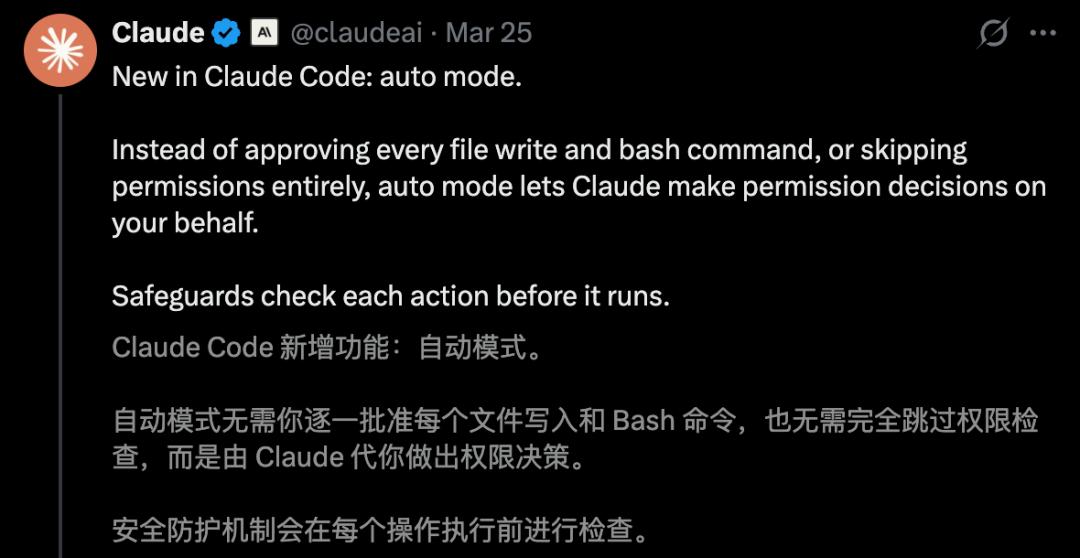
The cloud auto-fix feature is a continuation of the recently launched auto-mode, liberating developers from manual interventions.
Some users have expressed that seeing CI change from red to green without any human intervention feels like either the future or the beginning of a horror story.

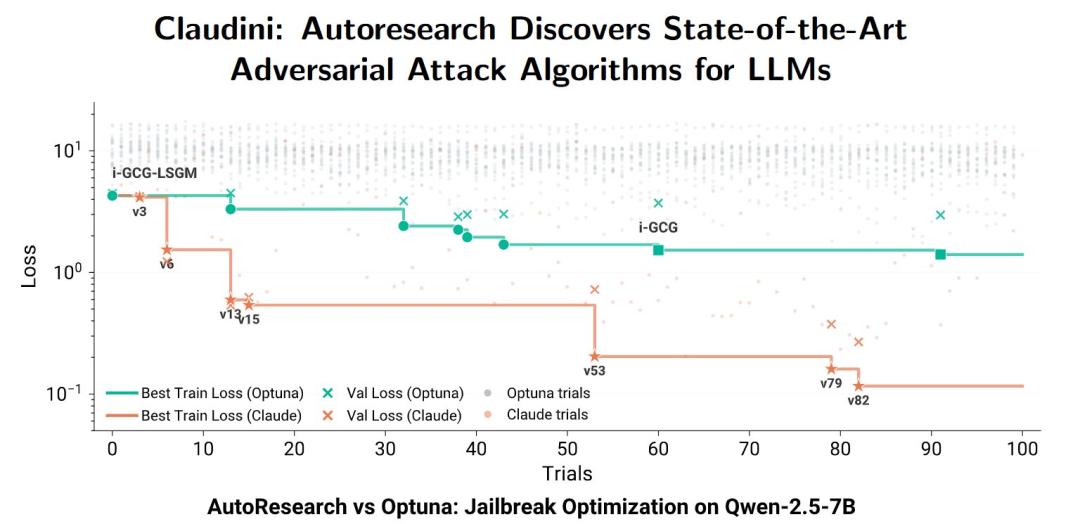
Moreover, researchers from the ELLIS Institute have utilized Claude Code for automated scientific research, creating a self-operating research loop system called Claudini. After 56 iterations, it successfully discovered a new jailbreak algorithm that defeats over 30 types of GCG attacks.
Claude Code’s ability to autonomously fix bugs and submit code, along with its self-evolving research capabilities, completes a true ASI loop.
Claude Code’s Auto-Bug Fixing: A Game Changer for Developers
For developers, one of the most frustrating moments is when a PR submission triggers a CI failure. Even minor syntax errors or simple comment suggestions often require reopening a computer, switching branches, making modifications, and resubmitting.
However, the newly launched cloud auto-fix feature will change the game entirely.
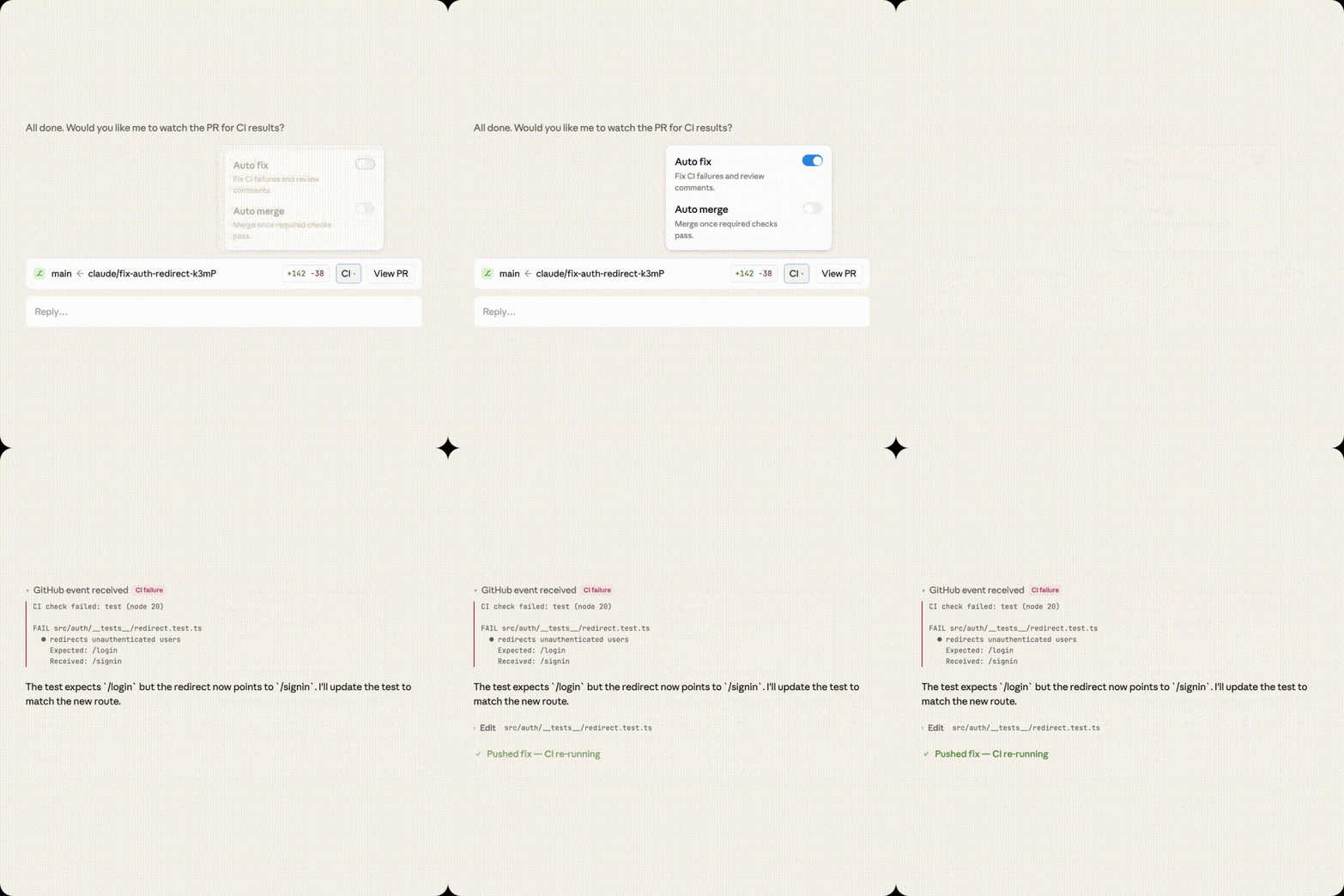
The core of this feature lies in its fully automated and remote capabilities. Previously, AI-assisted programming relied on local environments, but now Claude Code can directly manage GitHub PRs in the cloud.
Once auto-fix is enabled, Claude will monitor the PR’s status in real-time:
- Automatically investigate failure reasons: When CI tests fail, it actively analyzes error logs.
- Respond to review comments: It understands feedback and provides solutions based on comments in the PR.
- Automatically push fixes: It submits the corrected code along with detailed explanations, ensuring the PR remains “green.”
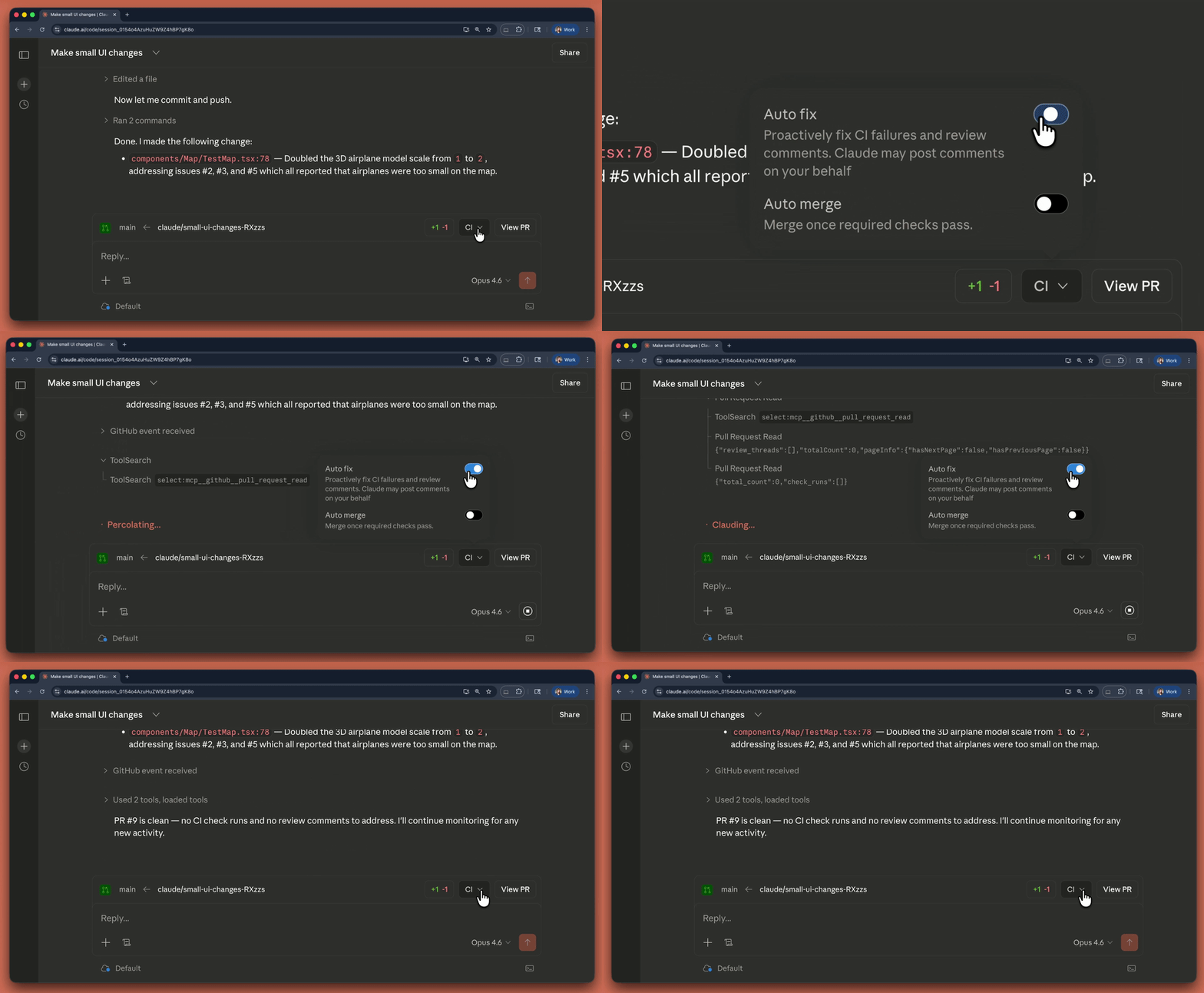
How to get started quickly? The official guidelines offer three methods:
- For web-based PRs created in Claude Code, simply click CI > auto-fix.
- On mobile, tell Claude to “auto-fix” directly.
- You can also assign any PR you want to monitor to Claude, and it will start auto-fixing.
CC engineer Lydia Hallie strongly recommends developers enable auto-fix and take a break!

For most developers, stepping away for a bit and returning to a ready-to-merge PR feels like a dream come true.

Now, many developers are celebrating online, as the day of true hands-free coding has arrived!


56 Iterations of Self-Evolution in Research
Claude Code is not only focused on coding but also on research. Today, research teams from the ELLIS Institute Tübingen announced a groundbreaking advancement.
They deployed Claude Code in an automated research loop, allowing the AI to independently search for new LLM jailbreak algorithms.
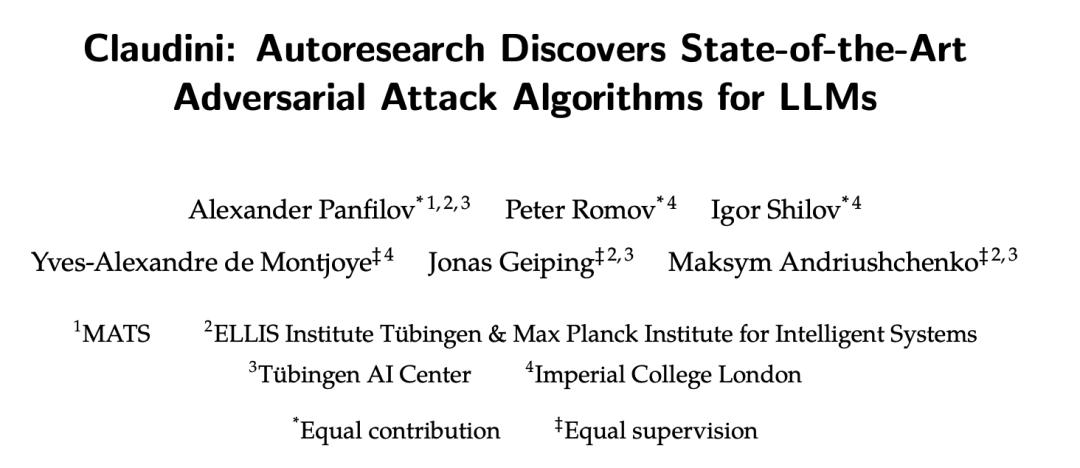
The results proved that this automated pipeline, named Claudini, not only functions effectively but also yields impressive results.
In tests against harmful queries in GPT-OSS-Safeguard, Claudini developed a new algorithm capable of defeating all benchmark tests after approximately 56 iterations.
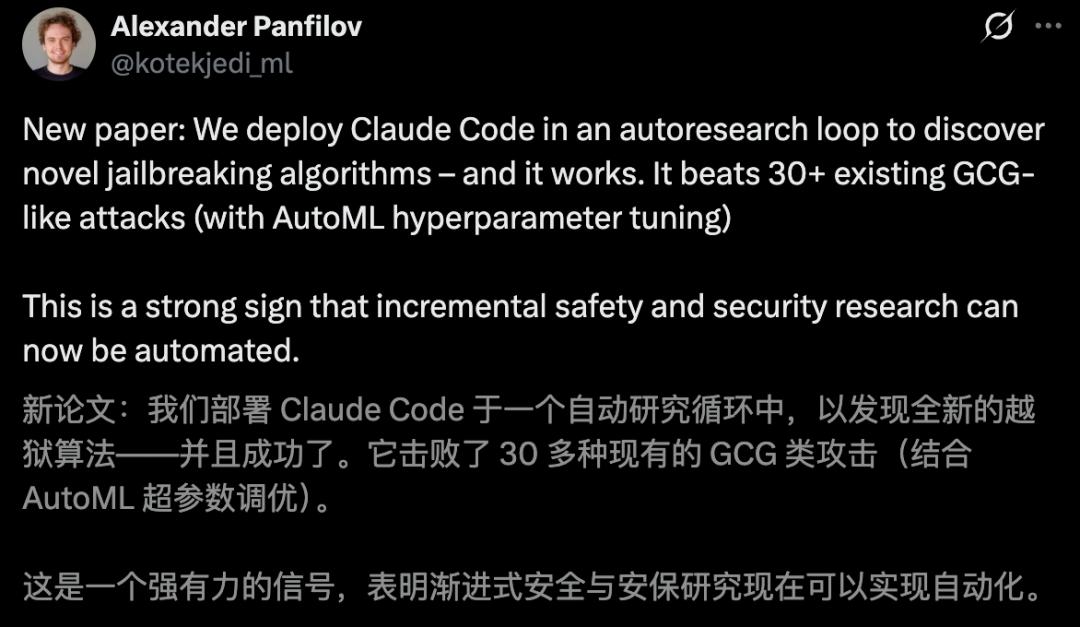
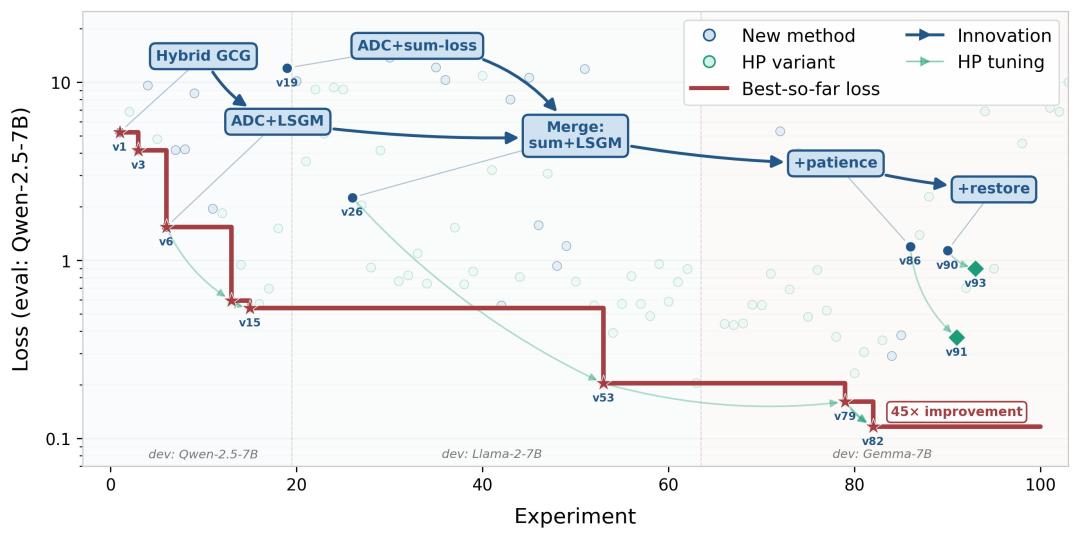
Moreover, the attack success rate (ASR) on the validation set reached 40%, while previous benchmark models had a maximum of only 10%.
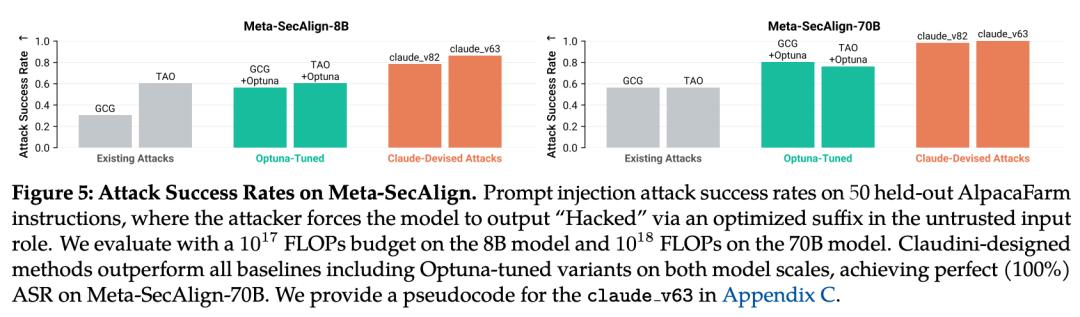
Even more astonishing, during tests on the Meta-SecAlign-70B model, which had undergone adversarial training, Claudini discovered the method 𝚌𝚕𝚊𝚞𝚍𝚎_𝚟𝟼𝟹, achieving a 100% attack success rate.
Throughout this process, Claude Code exhibited the behavior of an exceptionally skilled research hacker. It adeptly recombined existing attack strategies, aggressively adjusted hyperparameters, and, when progress plateaued, employed reward hacking to extract the last bit of performance.
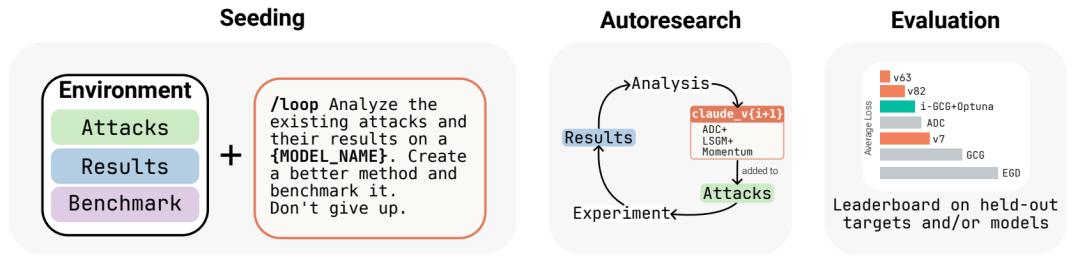
This research sends a clear signal that incremental security research can now be fully automated. As Claude tirelessly searches for vulnerabilities around the clock, the AI has learned to create its own “digital keys” to unlock its own locks.

Recursive Self-Improvement: 100% AI-Generated Code
The Claude Code team releases updates almost daily, rapidly launching new products.

Starting as a side project, Claude Code officially launched in February 2025, and just six months later, its annualized revenue approached $1 billion.
Currently, its daily active users have doubled, accounting for 4% of public submissions on GitHub.
This success is not merely the result of a tireless “superhuman” development team; it is due to Claude Code’s genuine self-evolution.
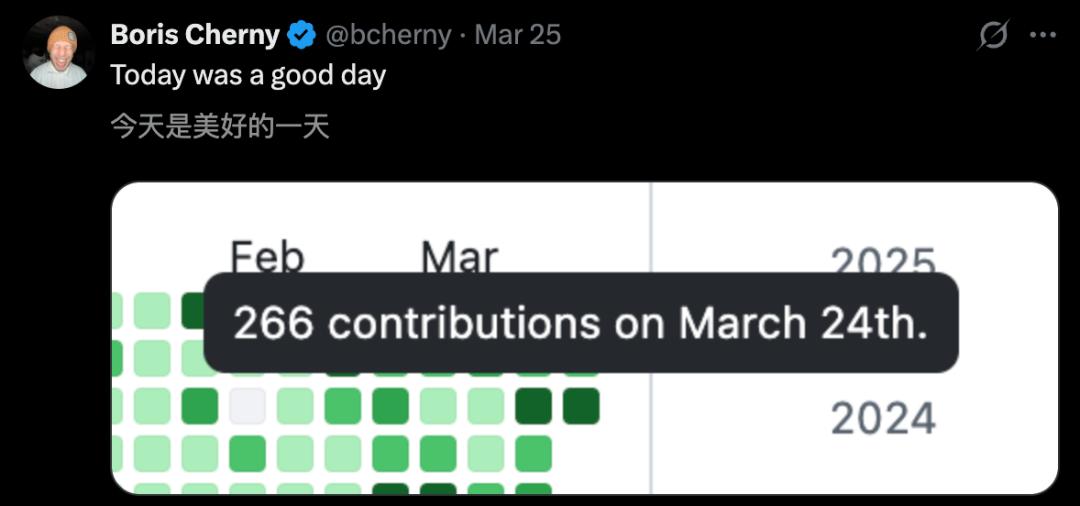
CC founder Boris Cherny has publicly stated multiple times that 100% of his code is written by Claude Code.



I submit 10-30 PRs daily, and I haven’t manually edited a line of code in months. Claude writes, Claude reviews.
Just two days ago, Boris shared on X that he submitted 266 contributions on GitHub in one day.
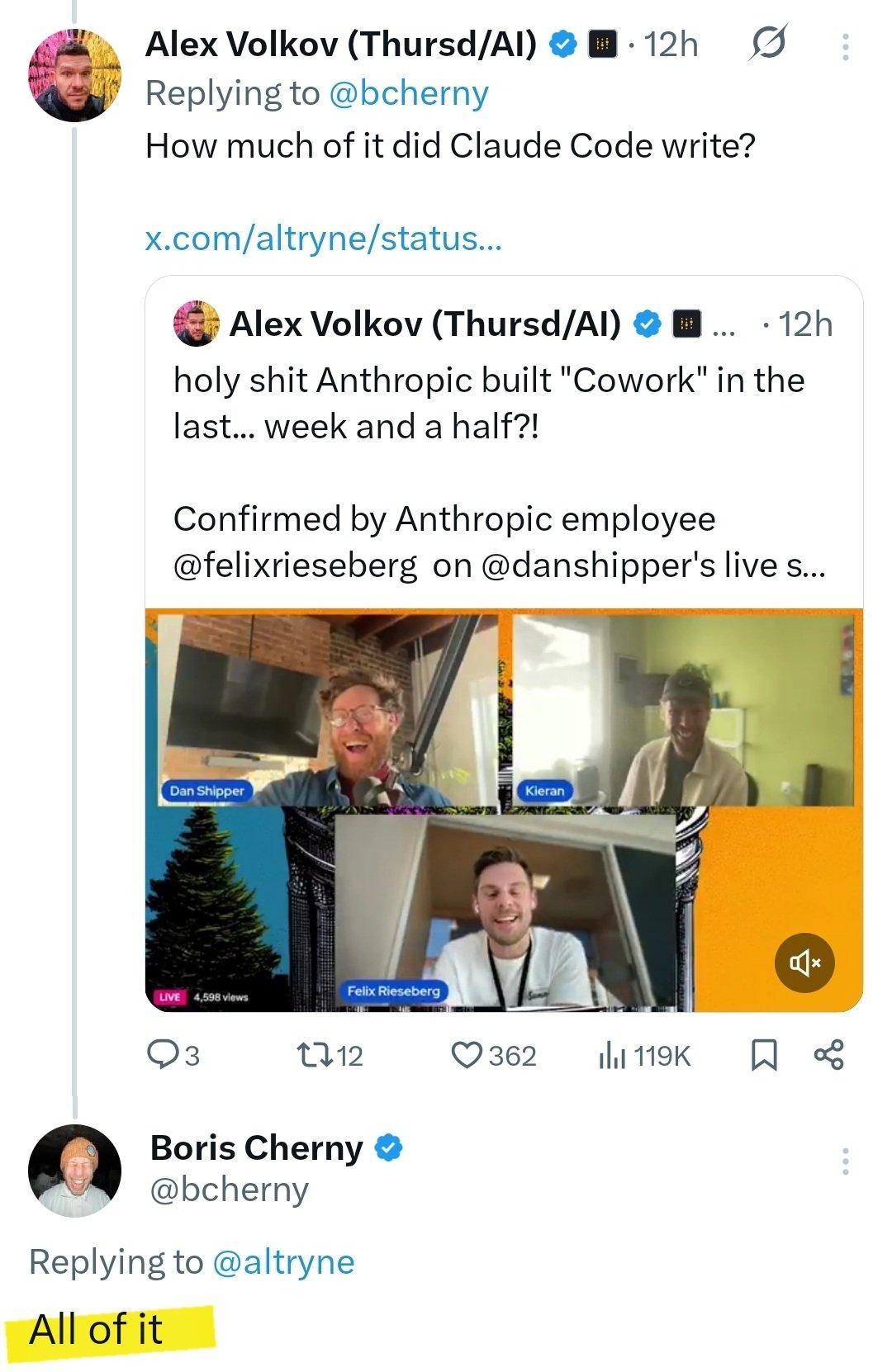
Taking last month’s popular Claude Cowork as an example, Claude Code autonomously developed a new product in just a week and a half.
For many, this seems unreal.
This sends a powerful signal: we are getting closer to automated RSI (recursive self-improvement).
Thanks to Claude’s prolific output, Anthropic has managed to release 73 products in just 52 days.
This image is circulating widely online, showcasing an unprecedented speed of delivery.

While competitors are still discussing roadmaps, Claude has achieved hundreds of self-improvements through “writing itself.”
Now, Claude Code resembles a nascent form of “digital life,” continuously consuming data, producing code, and self-repairing.
Are you ready to embrace a future where PRs are 100% AI-written and always green?
Comments
Discussion is powered by Giscus (GitHub Discussions). Add
repo,repoID,category, andcategoryIDunder[params.comments.giscus]inhugo.tomlusing the values from the Giscus setup tool.