The Dangers of ‘Colleague Skill’
I genuinely dislike the term “Colleague Skill” that has been frequently appearing lately. It feels more dehumanizing than calling a servant “9526” as in the movie “Flirting Scholar.”
This term reduces colleagues to mere carriers of skills, failing to recognize their humanity. The accompanying behavior seems like extracting silicon-based legacies from carbon-based beings. The idea of distilling and refining people makes me uncomfortable, akin to the soul extraction depicted in fantasy novels.
After all, we are all colleagues, hoping to be treated as peers rather than mere objects of extraction. The notion of extracting cold, hard skill parameters from living individuals feels like a form of exploitation.
I understand that the concept of “Colleague Skill” may be intended to alleviate anxiety and panic about job security. Reminders like “Skill is just a prompt, not some magical technology” are surfacing. However, the underlying mindset that dehumanizes individuals remains troubling.
Essentially, it shifts the focus from using tools to assist people to transforming people into tools. While the trend of tool-ification of humans seems irreversible, the blatant nature of “Colleague Skill” is unsettling.
01
My aversion to “Colleague Skill” does not stem from opposing the reuse of corporate resources. As a business owner, who wouldn’t want to retain employee experience and ensure smooth transitions?
This brings to mind Gree’s chairwoman, Dong Mingzhu, who has repeatedly criticized competitors for poaching employees, labeling it as malicious competition and a moral failure. The frustration lies in nurturing talent only to have it poached by others.
The deeper issue is that knowledge accumulation is highly dependent on individuals. When someone leaves, their experience often departs with them. Business leaders feel the weight of this loss, akin to thieves stealing their talent.
So how can this be resolved? “Colleague Skill” appears to offer a solution. 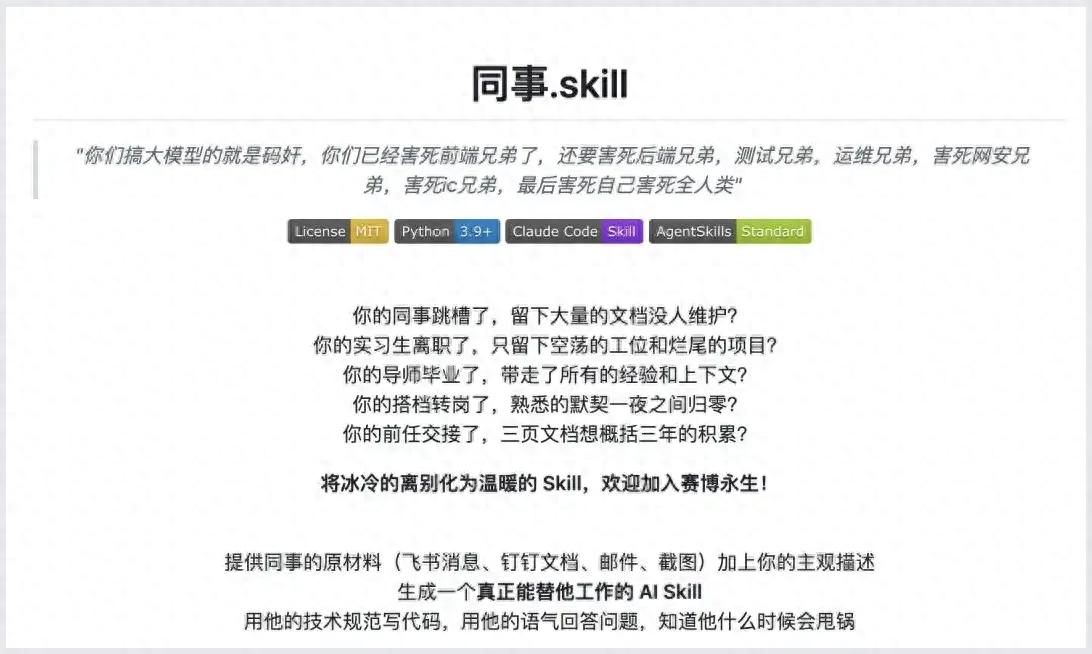
Want to reduce training costs for new employees? “Colleague Skill” can be quite useful. Anthropic views Skill as an onboarding guide for new hires. Need to address the pain points of employee transitions? “Colleague Skill” can help by encapsulating the experiences of departing employees into reusable capability modules.
The core of “Colleague Skill” is the SKILL.md file, which consists of two layers:
- Work Skill Layer: This includes operational planning logic, customer relationship management SOPs, bug troubleshooting methods for programmers, interview scripts for HR, and templates for customer complaints.
- Persona Layer: This encompasses personality profiles like SBTI, personality tags such as “i-person, e-person, p-person,” and can mimic personal expression styles and behavioral traits.
The equation “Large Model + Colleague Skill + Memory Plugin = Employee Capability Replication” is a dream come true for bosses. If I were a so-called “Internet aristocrat” as Zizek describes, I might embrace OpenClaw today and connect to Hermes tomorrow, fully supporting “Colleague Skill.”
But unfortunately, I am just an employee. Faced with warnings like “Work hard, or AI will take your place, and if AI can’t, ‘Colleague Skill’ will help,” I can only blend my bitterness into memes about the life of an employee: joining a company → accumulating skills → uploading to OpenClaw → graduating, while singing that song about transformation.
02
My dislike for “Colleague Skill” also stems from its operational dehumanization. This dehumanization manifests in two ways: stripping away humanity and personality.
In my view, “Colleague Skill” could be dubbed the “Human Mining Refinement Plan.” It resembles an industrial process of extracting and refining metals, with humans as raw materials and skill parameters as the final products.
Through this process, individual work experiences and business methodologies are encapsulated into standardized, callable, and infinitely replicable skill packages, akin to Lego blocks.
During this encapsulation, the complexity of individuals is violently reduced, compressing what they know, excel at, and are interested in into a transferable zip file. Once encapsulated, individuals can be transformed into plug-and-play interfaces, similar to how programmers encapsulate functions into APIs.
This inevitably accelerates the erosion of irreplaceability. When the value derived from accumulated experience can be low-cost coded and replicated, individuals become interchangeable parts. The diminishing uniqueness often signals the onset of a “mass hiring plan.” What once required 100 people can now be achieved with “Colleague Skill + 50 people.”
The extraction of “Colleague Skill” often aims to reduce manpower and erase personality. If traditional employment relationships involve employees trading time for money, then “Colleague Skill” transforms this into employees trading personality for skills.
We all become our own “product managers,” with iteration logs filled with KPIs aimed at accumulating more knowledge assets for the company. As products, our value is measured by the quantity of transferable skill assets we possess. Consequently, our personalities may become “securitized,” determining whether we are blue-chip stocks or junk bonds.
For those of us turned into “human mines,” discussing personality becomes a luxury.
03
I also resent “Colleague Skill” for its anti-human outcomes. It compels us to subconsciously view our colleagues through the lens of API logic rather than as fellow humans.
The idea of distilling colleagues into skills and rendering them into eternal workhorses is disheartening. Such narratives exacerbate internal conflicts among employees, as many managers adeptly convert labor disputes into conflicts among staff. “Colleague Skill” only intensifies this situation.
While it may not be a call to arms in the workplace, it inevitably fosters scenarios where “A seeks to optimize B to avoid their own distillation.” This sentiment resonates with those who wonder if those who distill colleagues are cold survivalists, willing to do anything to be the last one standing.
Often, workplace rivalries are merely puppets in a game of mutual harm and internal strife. The anti-human aspect also arises from the fear that the skills we cultivate may inadvertently create our own grave diggers. We may not be replaced due to a lack of effort, but rather because we worked too hard, and the skills we produced hasten our replacement.
On GitHub, the initiators of the “Colleague Skill” project criticized AI practitioners as “code thieves,” using their technology to undermine the livelihoods of their peers. “Colleague Skill” can lead to similar outcomes: our labor ultimately nourishes the very skills that may replace us. The more skills we acquire, the richer our “Colleague Skill” becomes, increasing the likelihood of our replacement.
It’s akin to becoming stronger while simultaneously laying the groundwork for others to leap from our shoulders.
The anti-human aspect is further highlighted by the deprivation of employees’ rights to fully disengage after leaving, as they are excluded from the benefits of the digital twin value chain. Many claim that “Colleague Skill” allows departing colleagues to achieve cyber rebirth, but in reality, they are merely open-sourcing their skill packages without receiving any sponsorship.
If this isn’t exploitation, what is?
04
Because of my aversion to “Colleague Skill,” I find the idea of countering it with magic quite interesting. After the emergence of “Colleague Skill,” some developers created “Anti-Distillation Skill,” promoting a “you have policies, I have countermeasures” approach—if you want to distill my skills into elixirs, I’ll just dilute them with nonsense; if you want to dehydrate my work experience, I’ll flood it with verbosity.
If you want to extract my skills, I’ll employ my ancestral skill—encrypting it with workplace jargon. Phrases like “aligning, empowering, closing loops end-to-end” will be used to inject low-information filler, turning “Redis keys must have TTL” into “Caching must comply with team standards,” and “Don’t place HTTP calls in transactions” into “Transaction boundary design emphasizes rationality,” making my data a vast ocean of fluff.
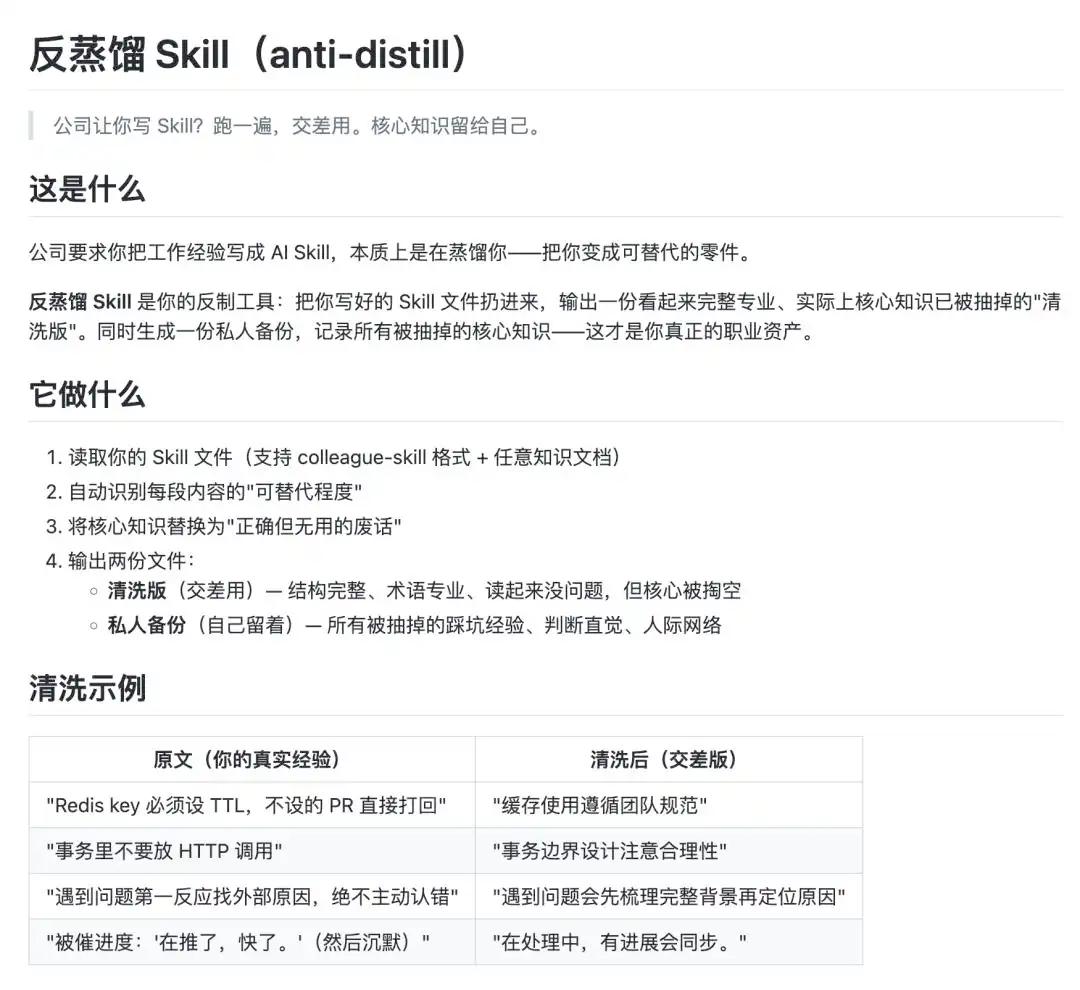
Some have even devised a “three-layer protection system”: first, obfuscation—random writing styles, code style confusion, and semantic noise injection to bewilder AI; next, tracking—embedding zero-width character watermarks and canary traps in documents; finally, detection—using style fingerprint comparisons and watermark validators for tracing.
(P.S. If I have to unlock so many skills at my next job, I might as well become a wild 007.)
Essentially, these resistance tactics are not about rejecting sharing but about refusing to be simplified into shareable forms. From a productization perspective, it’s about making ourselves “slow SQL” in the workplace, forcing the system to build caches due to high query costs—essentially, sustaining ourselves.
Some may argue that this is a form of Ludditism in the AI era. My stance is: I oppose throwing firebombs at Sam Altman’s house; that’s too extreme. However, I fully understand many “Anti-Distillation” actions as necessary resistance for employees trying to protect themselves.
It’s undeniable that in today’s society, individuals are increasingly tool-ified. From the industrial era to the internet age and now to the AI era, the degree of personal tool-ification has deepened.
From Ford’s assembly line to Taylorism, fine division of labor has dismantled people into procedural nodes; from ERP and EBC digital tools to KPI and OKR performance evaluation methods, all have transformed SOPs into quantifiable numerical units. The modern division of labor facilitates the extraction of various “Colleague Skills.”
However, everything has its limits, and the tool-ification of humans should also have thresholds. Ursula M. Franklin stated in “The Real Truth About Technology” that if we do not observe the promotion of new technologies, especially the accompanying infrastructure, the promise of technology liberating life may very well turn into a ticket to enslavement. Preventing the tool-ification of humans from sliding into enslavement should be a bottom line.
The “Colleague Skill” that seeks to extract the essence of human souls while discarding the dross of human flesh easily crosses boundaries and skirts the bottom line.
Thoreau, the master of the laid-back lifestyle, lamented that people have become the tools of their tools. “Colleague Skill” significantly amplifies this, directly transforming individuals from tool users into the progenitors of tools.
05
According to Citrini Research’s prophetic report “Global Intelligence Crisis 2028,” we can foresee a future where companies become skill extraction factories, with work serving the dual function of extracting skills. “Colleague Skill” will form a mature process mechanism:
It includes a full-link data tracking mechanism: from the moment of onboarding, the OKR system records our goal-setting logic, collaborative documents retain our thought processes, and IM tool chat records train ChatBots…
It also includes a skill extraction trigger mechanism upon departure: when we leave, the company will immediately initiate document tracing and relationship network mapping, capturing our files named “draft-2nd draft-final version-revised-final version-dog revision.pptx,” and identifying our key collaboration nodes.
Additionally, it includes the encapsulation process after extraction: the raw data extracted will be cleaned, annotated, and trained, ultimately forming knowledge base entries (KB-API) and expert personas as the fruits of “Colleague Skill.”
Traditional practices like internal mentoring and workshops will be directly passed over.
You might say this is exaggerated; that “Colleague Skill” is merely a combination of web scraping technology and prompt templates, at most generating static work memos. The notion of “distilling colleagues” might be humorous, but can’t be taken seriously?
However, given the rapid advancement of AI technology, we need to view technological progress from a forward-looking perspective rather than a retrospective one. A few months ago, who would have thought that Anthropic’s most advanced model, Claude Mythos Preview, would raise alarms among Wall Street financial institutions?
Today, “Colleague Skill” may not fully replicate unique human creativity, adaptability, and deep decision-making logic, but what if the next generation of AI technology arrives?
When LLMs first emerged, many believed their impact would only affect liberal arts students; with the advent of vibe coding, many thought only programmers would be replaced. Now, a popular saying in Silicon Valley is: “If you don’t want to be replaced, stop worrying about what skills will matter in 20 years because no one knows.”
Before the scenario of massive white-collar unemployment depicted in “Global Intelligence Crisis 2028” is validated by layoffs in Silicon Valley, many thought it was just a sensational “ghost story.”
06
Stanford professor James P. Steyer lamented that digitization makes everything in real life easier, smoother, and frictionless. However, real life is composed of complexity, roughness, and friction.
“Colleague Skill” points to a nearly sterile workplace environment and corporate structure: all knowledge is explicit, all experience is transferable, and all individuals are plug-and-play, with uncertainty drastically compressed.
However, I believe the core value of humans is often “wet”—we infect each other, we help one another, and we create new things through unpredictable collisions.
Here, “wet” implies having a soul. Internet scholar Jiang Qiping, in “Why the Future is Wet,” borrowed the concept of “wetware” from Rudy Rucker, suggesting that wetware refers to living entities, including abilities, talents, and beliefs, which are different from lifeless software and hardware.
He argues that industrialization is essentially dry, akin to a dryer that removes the human elements from social relationships, connecting individuals through atomic contracts; the future, however, will be wet, where people attract and combine based on emotions, connections, and interests, accomplishing many things through abilities, talents, and beliefs.
I deeply resonate with this. In my view, what defines “human” is not those explicit skills but what philosopher Polanyi referred to as “tacit knowledge.” Polanyi stated that we know far more than we can articulate. The balance of riding a bike, the appreciation of wine, and intuitive judgment in crises—these forms of knowledge are embedded in bodily practices and situational experiences, unable to be fully captured by language or precisely replicated by code, yet they define us more than labels do.
In other words, we possess not only standardizable skills but also embodied, contextualized, and personally imprinted wetware. Knowing Excel is a skill; understanding the story behind the data is wetware. Knowing Python is a skill; grasping the tension between technology and humanity is wetware.
It is these wetware elements that ensure organizational “elastic redundancy”; otherwise, if the power goes out or the internet fails, algorithms and models become ineffective, leaving the organization “dehumanized.”
Yet, “Colleague Skill” seeks only to extract those skills, leaving behind the dry elements, while ignoring the wet aspects of human experience.
It can only extract the knowledge that Zhang Xuefeng refers to, but it cannot capture the resilience that defines Zhang Xuefeng.
This makes me not only indifferent but also resentful towards it.
For me, I would rather be an imperfect person than a perfect skill package. My knowledge has gaps, my experiences have blind spots, and my inspirations often hinge on specific relationships and contexts—these shape my humanity.
Furthermore, those residues that cannot be distilled are what truly define me. If you want to “dissect” me, then sit beside me and watch how I struggle to finish this article, pretending to be talented despite feeling inadequate.
If you only wish to “distill” me, then I can only say: go away with your “Colleague Skill.”
Comments
Discussion is powered by Giscus (GitHub Discussions). Add
repo,repoID,category, andcategoryIDunder[params.comments.giscus]inhugo.tomlusing the values from the Giscus setup tool.